
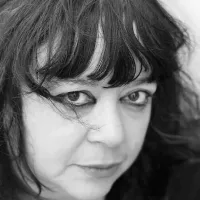
I dreamed I was reading a villanelle
in front of a crowd. Next to me on the floor
was a large bag of garbage I'd mistakenly
brought with me onto the stage. My own garbage.
And the crowd did not care about the villanelle.
Its intricacies or its subject, which was ornate
and thorny and probably none of my business.
I was a snob in the midst of a throng of people
hungry only for the truth. I have never played
the role of a snob or read a bad poem
into a microphone next to a sack of my own
garbage, in life or dream. What do you think
it means? Are the gods mocking me for acting
in-the-know? This would happen back home a lot.
Anybody who tooted their own horn
or dared to sound as if they were an expert
on any subject were mocked and driven
into the next county. Never hold yourself above.
There is no expertise. There is only good sense,
earned hard and held close to the vest.
It is not to be displayed but hoarded,
like canned goods in a storm cellar.
Go back for the garbage and deal with it.
In so doing, if you rouse a swarm of flies,
they're yours to tolerate or swat. Choose
your poison, but don't poison the well.
Your dreams are just dreams,
and all dreams go up in smoke.

TO WRESTLE WITH QUESTIONS ABOUT YOUR POETIC LEGACY, WHY NOT WRITE A VILLANELLE?
- “Villanelle” is titled for a traditional poetic form with complex, prescribed rules. Read this poem and notice, does it strike you as strict and formal? How would you describe the overall mood and tone of the poem?
- What do you feel is the significance of the bag of garbage? What might its appearance in a poem named for a classical form represent about the poet’s perspective and experience? What connections can you make between the garbage bag and what Seuss might be communicating about her personal history, working-class roots, views on high art, elitism, and messy life as a valid subject for poetry? What story do you believe the poet telling through this image in the context of the larger poem?
- Read two famous traditional villanelles—"One Art” and “The Waking”—and notice their precise patterns. Among other features, the traditional form has 19 lines (five tercets/three-line stanzas plus a closing quatrain/four-line stanza), as well as rhyme and repeating lines. Contrast this with “Villanelle.” How many lines and stanzas does this poem have? Do you notice repeated lines or rhymes at the ends of lines? What do you think about the way the poet subverts the traditional form? What is the impact of this subversion on you as a reader?
- Notice the diction in this poem. Seuss intentionally uses clichés such as “tooted their own horn” and “for acting in the know.” Why do you think she chose to use everyday, worn-out phrases in her poem? What is the effect?
- Listen to Diane Seuss reading poems from her book (see Useful Links below) and consider how you would recite “Villanelle.” Notice her conversational, direct, unvarnished style. How would you handle the rhythm of “Villanelle” to highlight the contrast between a poem that contains a rustling garbage bag and the traditionally smooth soundscape of a villanelle?
Writing activity: Try writing your own villanelle using contemporary language. Include at least one convention of the form—perhaps the repeating lines—to get a feel for the traditional form, while also making it new.
Useful Links
Listen to Diane Seuss reading from Modern Poetry, Left Bank Books, March 6, 2024 – (especially “My Education,” at 12.15 minutes, on similar themes to “Villanelle”)
Diane Seuss interviewed by Griffin Prize trustee Mark Doty, June 2, 2025
How a villanelle works: https://poets.org/glossary/villanelle
Diane Seuss, "Villanelle," from Modern Poetry. Graywolf Press, 2024. Reprinted with permission from the publisher.